8 Best Multilingual QR Menu Apps for Restaurants in 2026
A menu your guests cannot read is a menu that sells less. The best multilingual QR menu apps in 2026 let one printed QR code serve the same menu in every language your guests speak — and the real differences between platforms come down to two things: how many languages they support, and whether you must translate every dish by hand or the platform translates for you. Of the eight apps in this list, only two translate the whole menu automatically with AI; the rest give you empty text fields per language.
This guide ranks eight multilingual QR menu apps as of August 2026, with the translation method, language count and price for each.
Key Takeaways
- Two translation models exist: manual per-language text fields (most platforms) vs. AI translation of the whole menu (rare, faster, stays in sync).
- QR Menu Generator supports 17 languages with built-in AI translation of categories, dish names, descriptions and portion names — then lets you hand-edit any result.
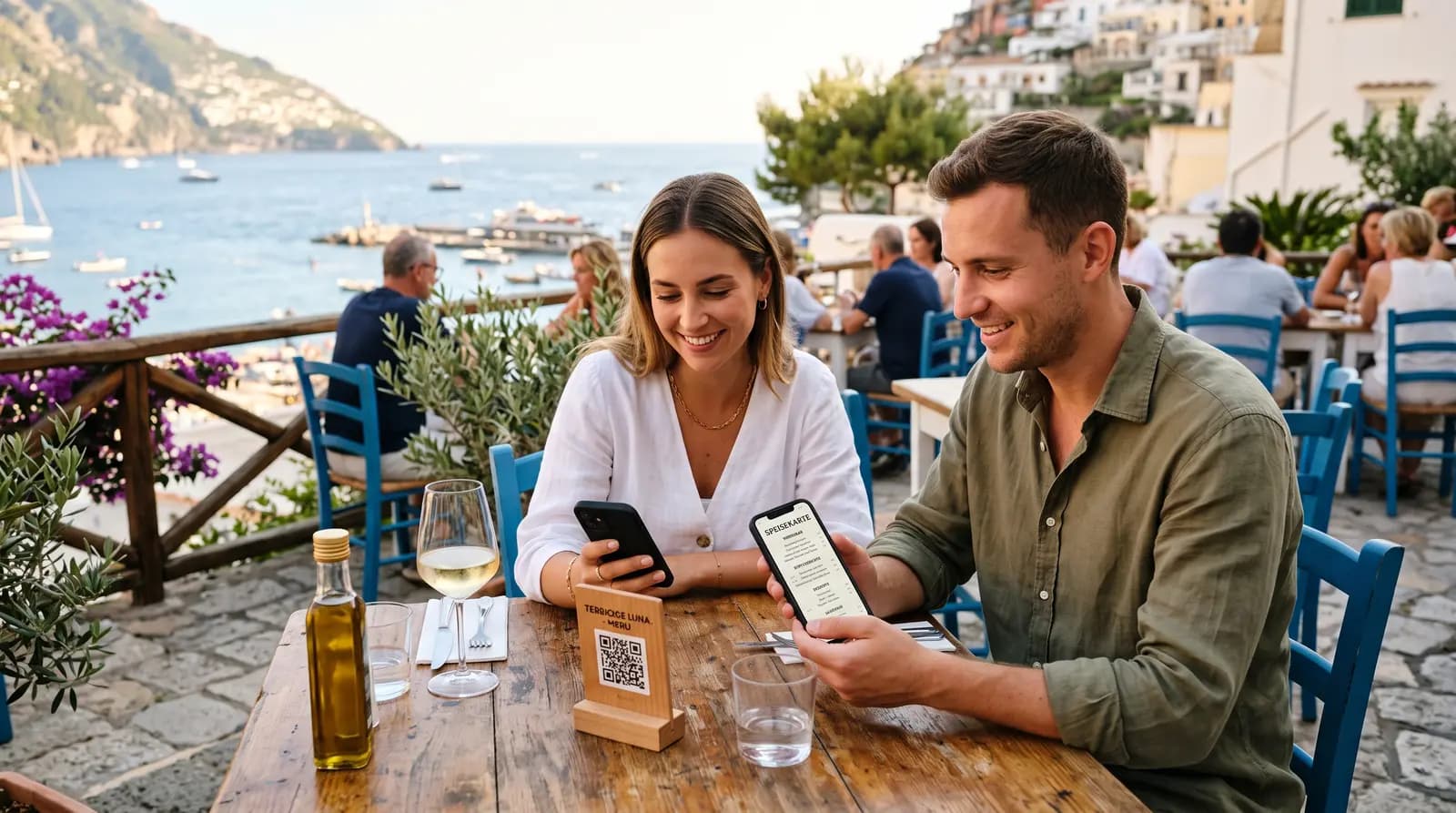
- One QR code serves all languages. Guests pick their language on-screen; you never print separate codes.
- Manual translation goes stale. Every dish you add or rename must be re-translated in every language — the hidden cost of "free" multilingual fields.
- Tourist-area restaurants need 3-5 languages, and adding more costs nothing on flat-rate platforms.
Table of Contents
Why a Multilingual Menu Pays for Itself
Guests order more when they understand what they are ordering. Studies of tourist-area restaurants consistently show that guests who cannot read the menu default to the safest, cheapest familiar item — or leave. A multilingual menu removes that friction for the cost of a few clicks.
Paper makes multilingual menus impractical: every language multiplies your print run, and every price change multiplies the reprint. A QR menu removes both problems — the same code shows each guest the menu in their language, and an update is live in seconds everywhere at once.
1. QR Menu Generator — Best for AI-Translated Menus in 17 Languages
QR Menu Generator treats languages as a first-class feature rather than an extra text field. The menu can be displayed in 17 languages (English, German, French, Spanish, Italian, Dutch, Portuguese, Polish, Turkish, Arabic, Russian, Greek, Bulgarian, Romanian, Croatian, Lithuanian and Georgian), and the built-in AI translation translates every category, dish name, description and portion name in one pass — you review and hand-edit anything you want to change.
The translation engine follows menu-specific rules: internationally known dish names such as "Tiramisu" or "Adana Kebap" keep their established form, brand names stay untouched, and allergen information is never dropped or altered. Guests see a language switcher when the menu opens; the printed QR code never changes.
The free plan includes the multilingual display with manual translations. AI translation runs on a credit system, with credits included on Pro ($9.90/month) and Pro Plus ($17.99/month). For EU restaurants, both paid plans also include the 14 mandatory allergen labels in every supported language.
Best for: restaurants in tourist areas and multilingual cities that want the whole menu translated in minutes, not typed language by language.
2. FineDine
FineDine is a tablet-and-QR menu platform popular with hotels and upscale restaurants, and multilingual support is one of its selling points. Menus can be offered in multiple languages with per-language content management, and the platform positions itself for international hospitality groups. Pricing sits at the premium end of the market and is quote-led for larger deployments — budget accordingly if you are an independent venue.
Best for: hotels and upscale venues that want multilingual menus as part of a broader guest-experience suite.
3. MenuTiger
MenuTiger supports multilingual menus through per-language fields: you add a language, then provide the translated text for your items. It is a capable mainstream choice with ordering features, but translation is manual — every new dish means re-typing it in every language you offer. Plans are priced per store and per table count, which raises the effective price as you grow.
Best for: restaurants already on MenuTiger for ordering that need to add one or two languages and do not change the menu often.
4. Menubly
Menubly is one of the cheapest flat-rate QR menu tools and includes a multilingual menu option where you supply translations per language. The economics are attractive — the Pro plan is under $10/month — but as with most platforms in this list, keeping three or four languages in sync is your job, not the software's.
Best for: budget-conscious single venues with a short, stable menu that rarely changes.
5. UpMenu
UpMenu is an online-ordering platform with QR menu support and multilingual capability aimed at restaurants that sell through their own website. Language versions are managed manually. Pricing starts around $49/month, which only makes sense if you also use the ordering and marketing features — as a pure multilingual menu it is expensive.
Best for: restaurants that want ordering, a website and a multilingual menu from one vendor.
6. GloriaFood
GloriaFood's core is free online ordering, and its menu can be presented in the language you write it in, with additional language handling geared toward its ordering flow. Restaurants use it primarily for the free ordering system; multilingual menu presentation is workable but not the product's centre of gravity.
Best for: restaurants whose priority is free online ordering, with languages as a secondary concern.
7. QR TIGER
QR TIGER is a general-purpose QR code platform whose menu product supports multiple languages on the digital menu. It is a good fit if you also need dynamic QR codes for marketing beyond the menu. As a dedicated restaurant menu system it is lighter than the specialists above, and translation is manual.
Best for: businesses that want one vendor for all their QR codes, menu included.
8. MustHaveMenus
MustHaveMenus is a menu design platform (print + digital) with QR menu publishing. Its strength is design templates rather than language automation; multilingual menus are achieved by creating language versions of your design. If your brand lives on beautifully designed menus and you have the staff time to maintain versions, it works.
Best for: design-led brands that also print physical menus.
Side-by-Side Comparison
| App | Translation method | Languages | Entry price for multilingual |
|---|---|---|---|
| QR Menu Generator | AI (automatic, editable) + manual | 17 | Free (manual) / $9.90 with AI credits |
| FineDine | Manual per language | Multiple | Premium, quote-led |
| MenuTiger | Manual per language | Multiple | Paid plans, per store + table |
| Menubly | Manual per language | Multiple | ~$7.99-9.99/mo |
| UpMenu | Manual per language | Multiple | From ~$49/mo |
| GloriaFood | Manual, ordering-centric | Limited | Free core |
| QR TIGER | Manual per language | Multiple | Paid QR plans |
| MustHaveMenus | Design versions per language | Manual | ~$49/mo Pro |
Language counts and prices checked August 2026 — verify current details on each vendor's site before deciding.
How to Choose a Multilingual QR Menu App
Ask three questions. How often does your menu change? If weekly, manual translation will not survive contact with reality — you need AI translation. How many languages do your guests actually speak? Count your top visitor nationalities; three to five languages covers most tourist areas. Do you need ordering too? If yes, weigh the ordering platforms (UpMenu, GloriaFood, MenuTiger); if you need a menu guests read at the table, a dedicated menu tool is cheaper and simpler.
If the answer to the first question is "often" and you serve international guests, an AI-translating platform pays for itself the first week: translating a 60-item menu into four languages by hand is an afternoon of work, repeated every time the menu changes.
Frequently Asked Questions
Does one QR code work for all languages?
Yes. The code opens the menu; the guest picks a language on-screen (or the menu pre-selects it from the phone's settings). You never print separate codes per language.
Can I edit an AI translation if a dish name comes out wrong?
On QR Menu Generator, yes — every AI translation is stored per item and editable like any other text. Fix it once and it stays fixed.
Do multilingual menus help with EU allergen rules?
They can. EU Regulation 1169/2011 requires allergen information for every dish, and guests must be able to understand it. Platforms that ship standardised allergen labels translated into each menu language remove the risk of a mistranslated allergen — QR Menu Generator includes all 14 mandatory EU allergen labels in every supported language on paid plans.
Will a multilingual menu slow the page down?
No — languages load on demand. The guest's chosen language is the only one rendered, so a 17-language menu opens as fast as a single-language one.
Bottom line: if your guests speak more than one language, the question is not whether to go multilingual — it is whether you want to type every translation yourself. In 2026, you no longer have to.
Frequently Asked Questions
- What is the best multilingual QR menu app in 2026?
- For restaurants that want the menu translated automatically, QR Menu Generator supports 17 languages with built-in AI translation of every category, dish name, description and portion name. For restaurants happy to type every translation by hand, most mainstream QR menu platforms — MenuTiger, Menubly, UpMenu and others — offer a manual multilingual field per item.
- How do multilingual QR menus handle translation?
- There are two approaches in 2026. Manual: the platform gives you an extra text field per language and you type or paste each translation yourself. AI-powered: the platform translates the whole menu automatically and lets you edit the result. Manual is free but slow and goes stale every time you change a dish; AI translation keeps every language in sync.
- Do customers pick their own language on a QR menu?
- Yes. Good multilingual QR menus show a language switcher when the menu opens, and many pre-select a language based on the visitor's phone settings. The QR code itself never changes — one printed code serves every language.
- How many languages does a tourist-area restaurant actually need?
- Three to five covers most cases: the local language, English, plus the two or three most common visitor nationalities. Coastal Mediterranean restaurants typically add German, French or Russian; central European city restaurants add Spanish and Italian. Adding languages costs nothing extra on flat-rate platforms, so err on the side of more.
- Is Google Translate good enough for a restaurant menu?
- Not reliably. Generic translators mangle dish names — 'çiğ köfte' becomes 'raw meatballs', which alarms rather than sells. Purpose-built menu translation keeps established dish names ('Tiramisu', 'Adana Kebap') in their internationally known form and translates descriptions with culinary vocabulary.
About the author
Evrenus Fırat Polat
Restaurant technology expert and founder of QR Menu Generator. Passionate about helping restaurant owners harness digital tools to grow their business.